Central Switzerland
The lake that gave the country its shape, and the meadow where it began.
Central Switzerland doesn't announce itself. It appears slowly — in the light on Lake Lucerne at six in the morning, in the smell of hay on a mountain path above Weggis, in the sound of a church bell crossing the water from somewhere you can't quite place. This is the region where the Alps begin and the lake reflects everything back at you. It rewards those who stop moving long enough to see it.
Destinations in Central Switzerland


Slow travel in Central Switzerland
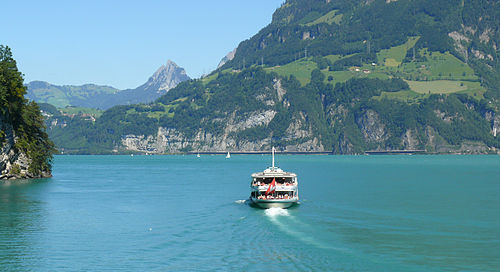
Lake Lucerne is not a simple shape. It twists into four arms, the basin below the city, the Uri arm stretching south toward the Gotthard, the Küssnacht Bay to the north, the Alpnach arm toward Pilatus,each one a different valley, a different character. The only honest way to understand it is to be on it. The Rigi rises from the eastern shore. Europe's oldest mountain railway reached its summit in 1871, and the line still runs. From the top, the lake below looks like something folded into the mountains rather than placed between them. The Pilatus, across the water, is reached by the world's steepest cogwheel railway, running on a gradient of 48 percent. Engelberg and the Titlis, at 3,020 metres, sit further south, a 45-minute train from Lucerne into a different altitude entirely. Lucerne itself is the region's centre. The Kapellbrücke dates to the 14th century, rebuilt after a fire in 1993 but still the oldest wooden bridge in Europe. The old town is compact and dense with detail: guild houses, fountains, the water tower standing in the Reuss. The lake begins at the edge of the old town and immediately opens. South of the city the Uri arm narrows and deepens. The Rütli Meadow sits on its western bank, where representatives of Uri, Schwyz, and Unterwalden swore their mutual defense pact in August 1291. Switzerland's name comes from Schwyz. The Federal Charter is still on display in its capital. This is where it started. The Gotthard Panorama Express runs from Lucerne by boat to Flüelen, at the lake's southern end, then continues by panorama train over the Gotthard into Ticino. The boat takes two and a half hours. That part alone is worth the journey.