Bern region Mürren
Mürren
Plan your trip
A handcrafted itinerary for Mürren.
SleepFind your stay
A short, curated list. None of them a chain.
GuidesFollow a route
Hand-curated, walked before written.
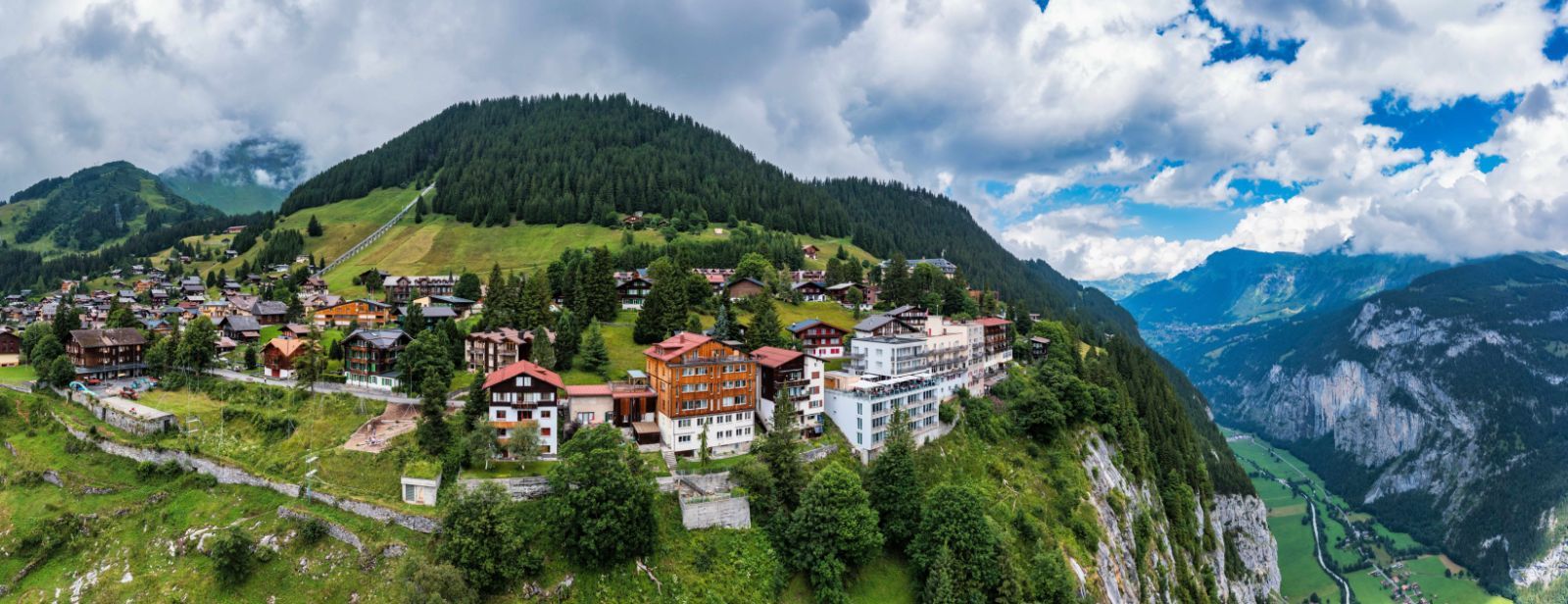
Mürren sits on a shelf of rock 1,650 metres above the Lauterbrunnen Valley, reachable only by cable car from Stechelberg or by train via Grütschalp.
No road connects it to the outside world. The village faces the Eiger, Mönch and Jungfrau directly, without a single building or tree line in between. Part of the Bernese Oberland, it counts fewer than 500 permanent residents and has kept that scale deliberately, even as its ski history made it internationally known.
What makes Mürren slow travel perfect
Mürren is what happens when a village has no room to grow. Built along a narrow cliff edge, it never grew past a few hundred people, and the absence of cars keeps it that way: the loudest sound on the main street is often a suitcase on cobblestones. In 1924, Arnold Lunn founded the Kandahar Ski Club here, and in 1931 Mürren hosted the first-ever World Championships in alpine skiing. That history still shapes the place. The Inferno race each January sends over a thousand skiers down 15 kilometres to Lauterbrunnen, a course first raced by seventeen Kandahar members in 1928.
In summer the mountains take over. The Allmendhubel funicular climbs above the village to a network of panoramic trails, and the walk down past the Sprutz waterfall lets hikers pass behind the falling water itself. The Mürrenbach Falls, dropping 471 metres in five cascades, rank as the highest waterfall in Switzerland and are visible from the cable car on the way up to the Schilthorn. At the summit, the revolving restaurant at Piz Gloria turns slowly through a 360-degree view of roughly 200 peaks, the same platform used in the 1969 Bond film that put Mürren on a different kind of map. For those who want the mountain without the elevator, the via ferrata to Gimmelwald crosses a 90-metre suspension bridge above the valley floor.
What stays with visitors isn't a single view but the rhythm of the place: fifteen minutes to walk the whole village, then hours to spend on a trail with nowhere else to be.